


Retirement Planning in India is one of the most important financial decisions you’ll ever make. Knowing how much money you’ll need after retirement helps you prepare for rising inflation, healthcare costs, and a longer life expectancy while ensuring financial independence.
You must have pondered upon this thought a lot. But think back to how our parents planned for retirement: work at the same company until 60, collect a lump sum gratuity, put it into bank fixed deposits, and live off the interest.
If you try using that exact same playbook today, you will run out of money.
With medical expenses surging, inflation eating into everyday savings, and life expectancy stretching well into our 80s, retirement isn’t just about “stopping the work”—it’s about funding 20 to 30 years of your life without a monthly salary check.
Here is a simple, no-jargon guide to figuring out your number, adjusting for inflation, and getting your money working for you today.
Before jumping into calculations, you need to know the three forces working against your retirement savings.
1. Inflation
General inflation in India runs around 5% to 6% per year, but lifestyle inflation is closer to 7%. If your household spends ₹60,000 a month today, in 20 years, maintaining that exact same standard of living will cost roughly ₹2.3 Lakhs a month.
2. Healthcare Costs Are Rising Even Faster
Medical inflation in India runs at roughly 10% to 12% annually—almost double general inflation. A hospital stay or medical procedure that costs ₹3 Lakhs today could easily cross ₹15 Lakhs by the time you turn 60.
3. You Will Likely Live Longer Than You Think
Thanks to modern medicine, planning for a lifespan of 80 to 85 years is the new baseline. If you retire at 60, your savings must cover every single bill, rent payment, grocery run, and holiday for at least 20 to 25 years.
Also, here is the quickest three step formula to find your retirement age.
The 3-Step Formula to Find Your Retirement Target
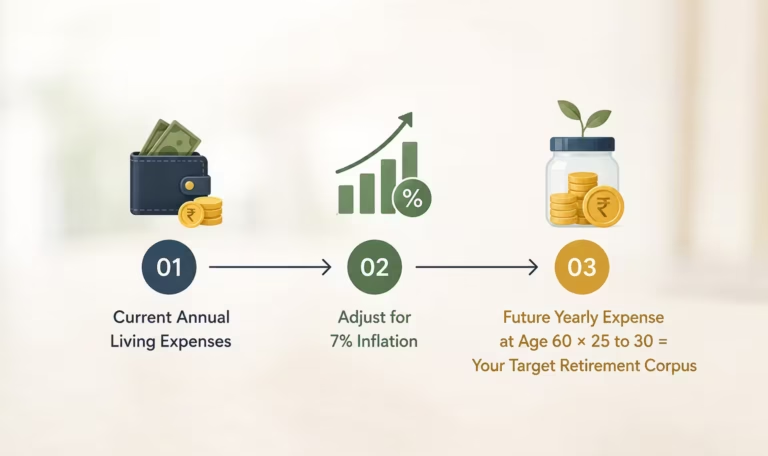
Let me break it down for you –
- Find your core baseline: Take your current monthly living expenses and multiply by 12. Skip short-term costs like home loan EMIs or school fees that will end before retirement.
- Project for inflation: Multiply that annual number to see what it will cost when you turn 60 (assuming an average 7% yearly inflation rate).
- Apply the 25x–30x Rule: Multiply your projected year-one retirement expense by 25 to 30. This creates a cushion large enough to generate steady income without exhausting the principal amount.
A well-planned retirement planning in India strategy helps you estimate your retirement corpus, choose suitable investments, and achieve long-term financial security.
The Money You Already Have Counts
The good news? You aren’t starting from scratch. You likely already have active investments doing the heavy lifting in the background:
- Employees’ Provident Fund (EPF): That monthly salary deduction grows with compound interest and acts as a solid debt base.
- Public Provident Fund (PPF): A safe, tax-free option under Section 80C with guaranteed government backing.
- National Pension System (NPS): A low-cost investment that locks in your capital until age 60, returning a tax-free lump sum and a monthly pension.
- Mutual Fund SIPs: The primary growth engine needed to outpace inflation over a 15–30 year timeline.
Why Starting Early Is Everything
Suppose you want to retire at age 60 with a lifestyle equivalent to ₹80,000/month in today’s money.
Accounting for inflation, your monthly requirement at age 60 will be roughly ₹3.4 Lakhs/month, meaning you need a total corpus of ₹8.5 to ₹9 Crores.
Here is what saving for that target looks like depending on when you start (assuming an average 12% return from equity mutual funds):
| Age Today | Years to Retire | Required Target Corpus | Required Monthly SIP |
| 30 Years Old | 30 Years | ~₹8.5 to ₹9.0 Crores | ~₹24,000 – ₹28,000 / month |
| 40 Years Old | 20 Years | ~₹8.5 to ₹9.0 Crores | ~₹85,000 – ₹95,000 / month |
| 50 Years Old | 10 Years | ~₹8.5 to ₹9.0 Crores | ~₹3,50,000 – ₹3,80,000 / month |
Also don’t you think, Waiting just 10 years to start (from 30 to 40) increases your required monthly investment by almost 3x. Time in the market is your biggest asset.